Gallery life
Artists’materials: wood
16.03.2026
Do we really know which materials we bring into our homes when we acquire a work of art? Their properties and symbolic meanings can influence the quality of our lives and, above all, our state of mind. An artwork is not only about ingenuity, creativity, or technique, but also about supports, binders, essences, and material details. Part of a gallerist’s work is precisely the knowledge of these aspects, which often require long periods of research to be fully understood.
From time to time, you will find insights on these topics here. The first focuses on the wood used by Tomonori Toyofuku in the 1960s.
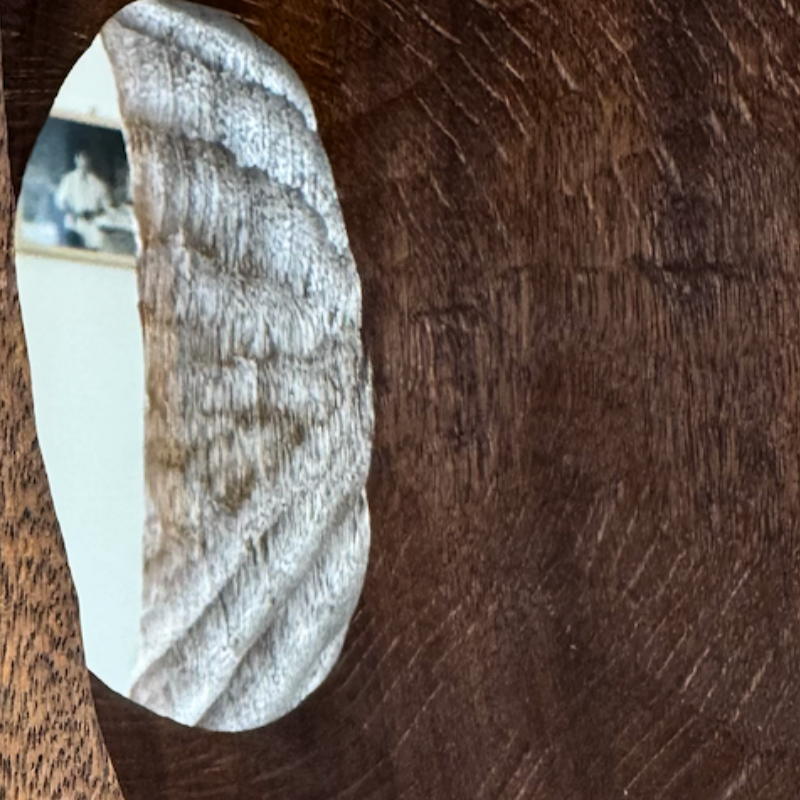
The Japanese sculptor often chose mahogany for his works, drawn both to its formal qualities and its physical properties. His sculptures feature abstract, pierced forms and recurring oval motifs, achieved through a process of carving and perforation that creates an intense dialogue between solids and voids. Mahogany—durable yet relatively easy to work—allowed him to create deep cuts and precise cavities while preserving the structural integrity of the piece. Its warm tone, regular grain, and smooth surface further enhance the relationship between light, form, and space that defines his sculptural research.
Mahogany is widely regarded as a symbol of strength, stability, and reliability. A solid and resilient wood, its remarkable hardness and resistance to warping in humid conditions make it a powerful metaphor for an inner strength that does not falter in the face of adversity.
In the picture: Tomonori Toyofuku, Untitled, 1987, carved wood, 42 × 23 × 18 cm. Detail.
ITAlY-JAPAN. Japanese artists in Milan since 1960s
until 30 April 2026
Corso Monforte 23, 20122, Milan