NEWS
Exhibitions
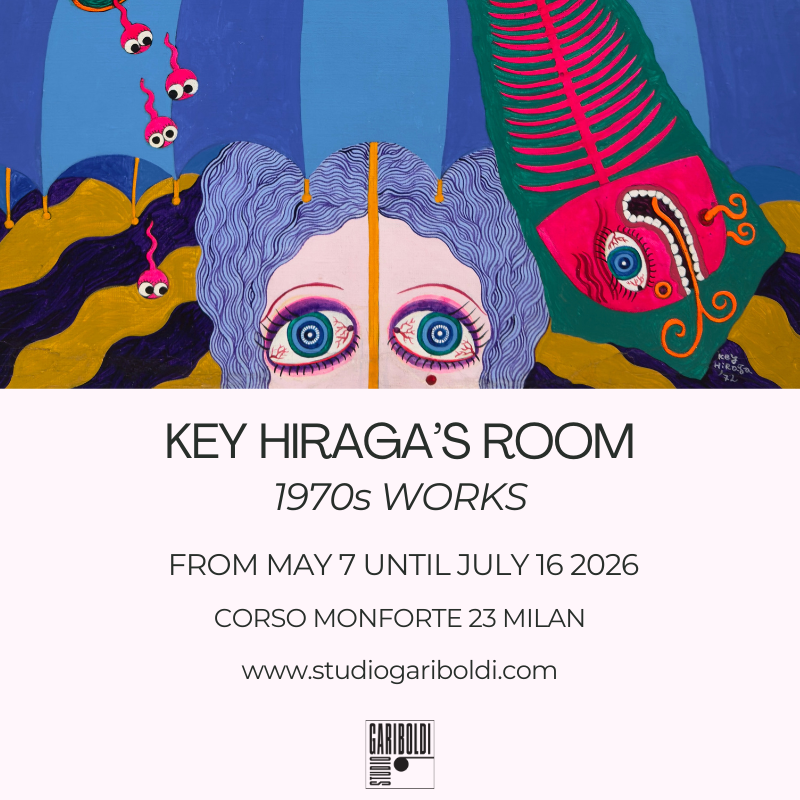
KEY HIRAGA’S ROOM
29.04.2026
KEY HIRAGA’S ROOM
1970s Works
7 MAY – 16 JULY 2026
As part of the project “Italy–Japan: Japanese Artists in Milan since 1960”, it will be possible to visit Key Hiraga’s Room, a new solo exhibition bringing together dazzling and psychedelic works, conveying the painterly energy and visionary imagination of the artist. The works on display feature the Paris of the Pigalle district, Hiraga’s main source of inspiration. We are in the mid-1960s, and the bustling nightlife of the French capital is translated onto his canvases into ironic and theatrical scenes populated by imaginary figures, enigmatic men, and sensual women. The body lies at the center of a continuous visual game, in which eyes, mouths, and ears transform and mutate, creating an immersive, almost cinematic experience, with some surprises for visitors who encounter the works up close.
In 1972, the Italian public encountered for the first time the exuberant works of Key Hiraga (Tokyo,1936 – Hakone, 2000), an eclectic protagonist of the postwar Japanese art scene. In 2015, after nearly half a century, Studio Gariboldi dedicated a retrospective exhibition to him, presenting a selection of works from the series The Elegant Life of Mr. K, created between the 1960s and 1970s. And now, we have the pleasure to present Key Hiraga’s Room, the second solo exhibition that Studio Gariboldi dedicates to the Japanese artist.
Pics: Key Hiraga, Untitled, 1972, oil on canvas, details, 65 × 54 cm.
Italy–Japan is held under the patronage of the Consulate General of Japan in Milan.
Monday – Friday
11:00 am – 1:00 pm | 2:00 – 6:00 pm
Saturday by appointment
Info: press@studiogariboldi.com
www.studiogariboldi.com
Corso Monforte 23, Milan
FullOfArt
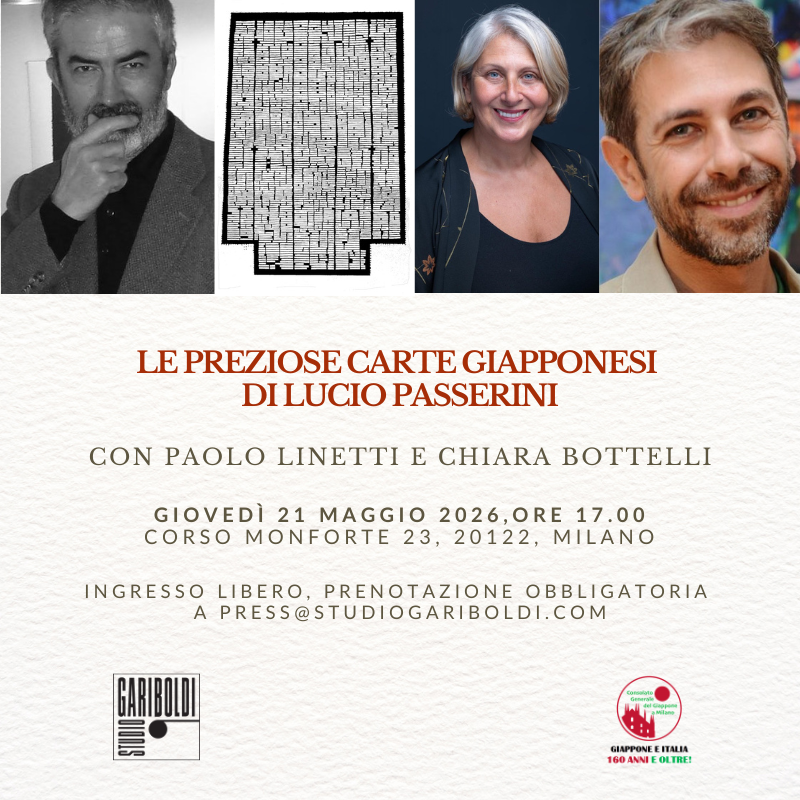
The precious japanese papers of Lucio Passerini
28.04.2026
Thursday 21 May, at 5pm
Paolo Linetti, an expert in iconography and symbolism, will guide us on a fascinating journey through the images evoked in the works of Lucio Passerini, artist, engraver, and typographer.
At the heart of the talk will be the relationship between sign, material, and support, with particular attention to the use of Japanese papers, chosen by the artist for their tactile quality and their ability to receive the imprint of printmaking as a sensitive and living space.
In Passerini’s practice, in fact, every element—from the paper to the typographic character—emerges from a deep dialogue with the content, in which materials and forms are conceived as an integral part of the creative process.
Under the patronage of the Consulate General of Japan in Milan.
Free admission!
We look forward to seeing you—reserve your spot here:: press@studiogariboldi.com
FullOfArt
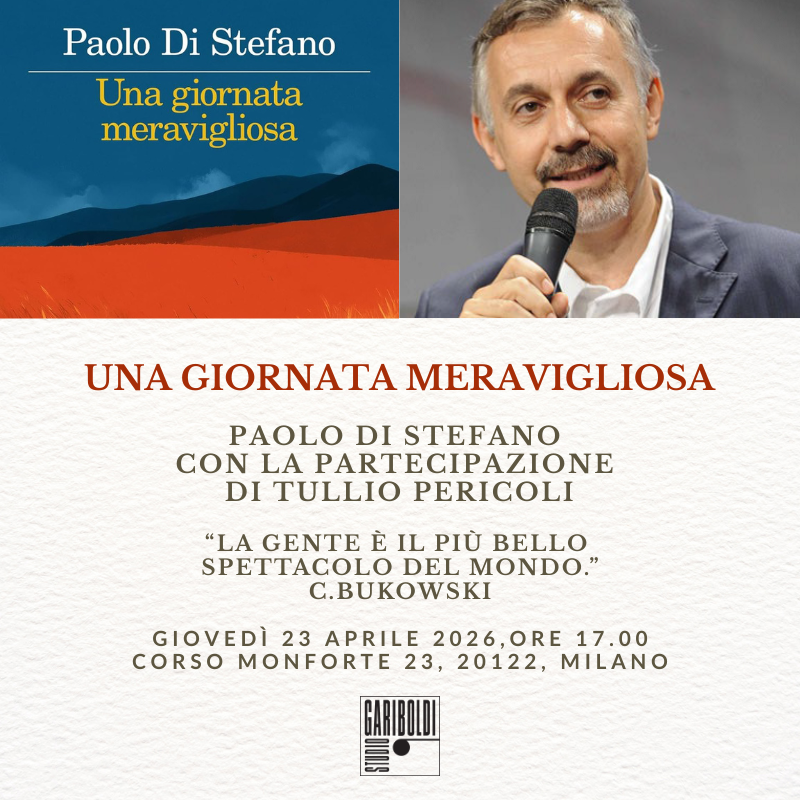
Una giornata meravigliosa
20.04.2026
On Thursday, April 23 at 5:00 pm, in the gallery spaces, writer and journalist Paolo Di Stefano and artist Tullio Pericoli will be present.
At the center of the meeting is the book Una giornata meravigliosa (Feltrinelli) by Paolo Di Stefano, an intertwining of lives that brush against one another: ordinary men and women with their fears, desires, and fragilities. Among them is also a journalist who enters into dialogue with an artist; together, they reflect on the meaning of making art and on the relationship between reality and representation.
The dialogue between Paolo Di Stefano and Tullio Pericoli thus becomes an opportunity to reflect on how words and images portray people, the human landscape, and the stories of our time.
The event will be moderated by Elisabetta Bucciarelli.
Free admission!
We look forward to seeing you, reserve your spot here: press@studiogariboldi.com
Art&Cinema
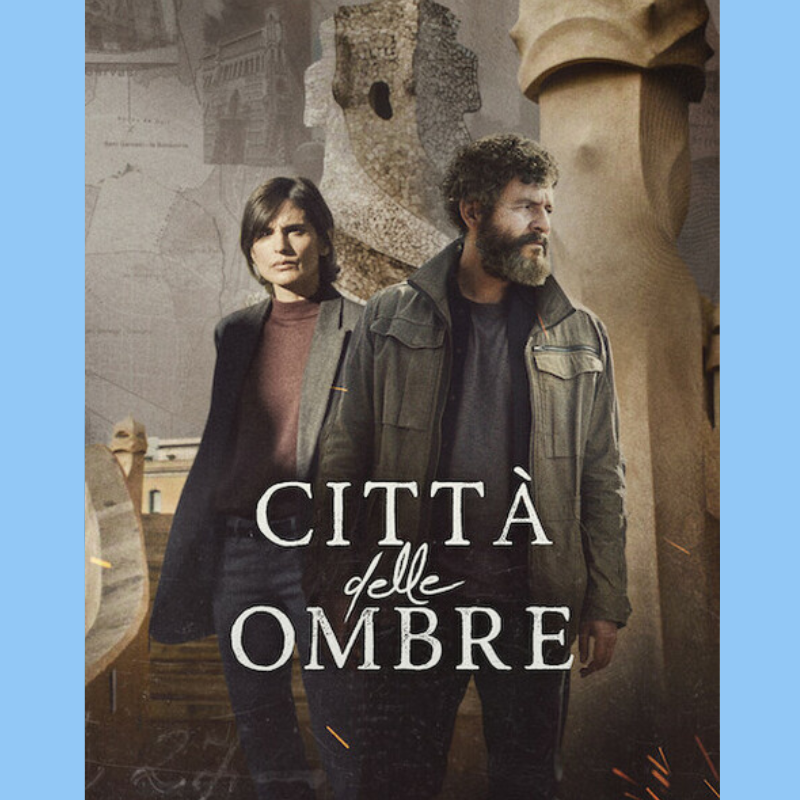
City of Shadows, TV Series
30.03.2026
There is a breath of stone that runs through Barcelona, an obsession with form. In the 2025 Spanish TV series City of Shadows, architecture does not merely host crime: it generates it, nourishes it, renders it sacred and terrible. Antoni Gaudí is no longer just a name, but a silent accomplice; his architectural curves become taut muscles beneath the city’s skin. Casa Milà rises like a petrified wave concealing emptiness, while its rooftop chimneys—unsettling, warrior-like sentinels—stand guard over secrets that should never be spoken.
The camera lingers on the wrought iron and stained glass of Casa Batlló, searching for a truth that shatters in the trencadís of Park Güell—that mosaic of fragments resembling the broken destinies of the protagonists. Inside the palaces, silence is heavy, furnished by the material figures of Manolo Valdés: his Meninas are mute presences, witnesses to a power passed down through frescoed walls and coffered ceilings. In the second episode, this silence becomes a scratch across the canvases of Antoni Tàpies: his abstract signs and the rough matter of his works hanging on the walls turn into walls of wounds, symbols of an inscribed suffering that disrupts the composure of noble rooms. The Sagrada Família looms like an unfinished prayer in stone, a labyrinth of light and shadow where the sacred slips into the profane. Perhaps for the first time, someone dares to pronounce a judgment on this work. We leave it to you to discover it.
The series belongs to the Noir genre and is currently streaming on Netflix. Recommended also for its inclusion of artworks, the quality of its storytelling, and its cast.
Gallery life
Artists’materials: metal
25.03.2026
Do we truly know which materials we bring into our homes when we acquire a work of art? Their physical properties and symbolic meanings can influence the quality of our lives and, above all, our state of mind.
A work of art is not made solely of ingenuity, creativity, or technique, but also of supports, binders, substances, and material details. The gallerist’s work also involves understanding these aspects, which often require long periods of research to be fully reconstructed.
After our in-depth features on wood and marble, used by the artists Tomonori Toyofuku and Aiko Miyawaki, we continue this journey with a third material: metal.
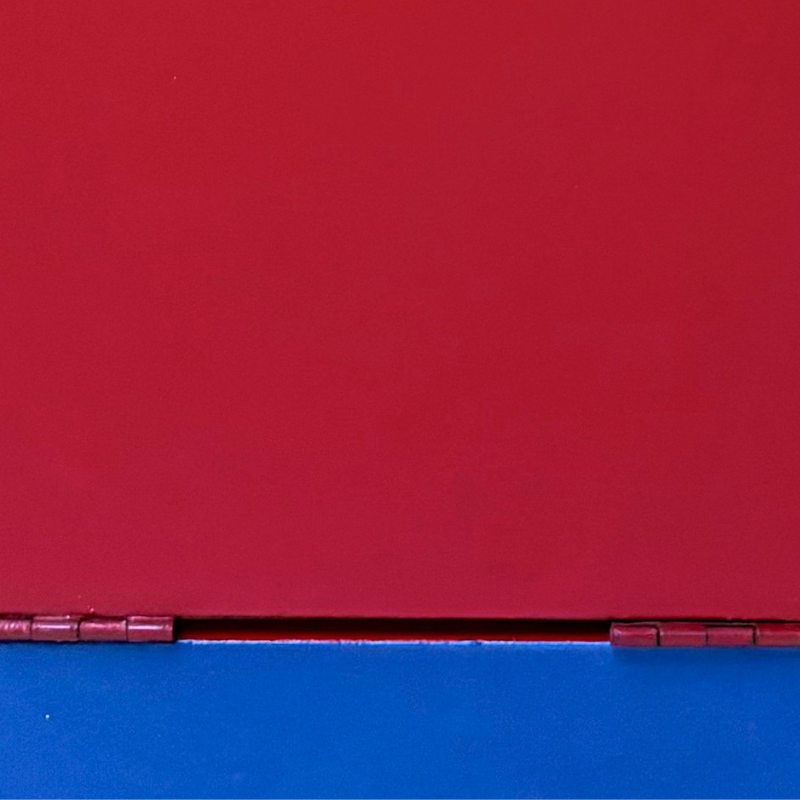
In the works of Katsumi Nakai, metal hinges transform painted panels into interactive, three-dimensional forms, suggesting movement, change, and a constant tension between surface and volume. At the same time, they evoke the Japanese concept of ma, the meaningful space between things. The hinges thus become symbols of transformation and openness, activating a dynamic dialogue between matter and space and turning static surfaces into ever-evolving forms.
In the image: Katsumi Nakai, Untitled, 1968, acrylic on shaped wood, detail.
ITALY–JAPAN. Japanese artists in Milan since 1960
until April 30, 2026
Corso Monforte 23, 20122, Milan
FullOfArt
Criticism according to Carla Lonzi
24.03.2026
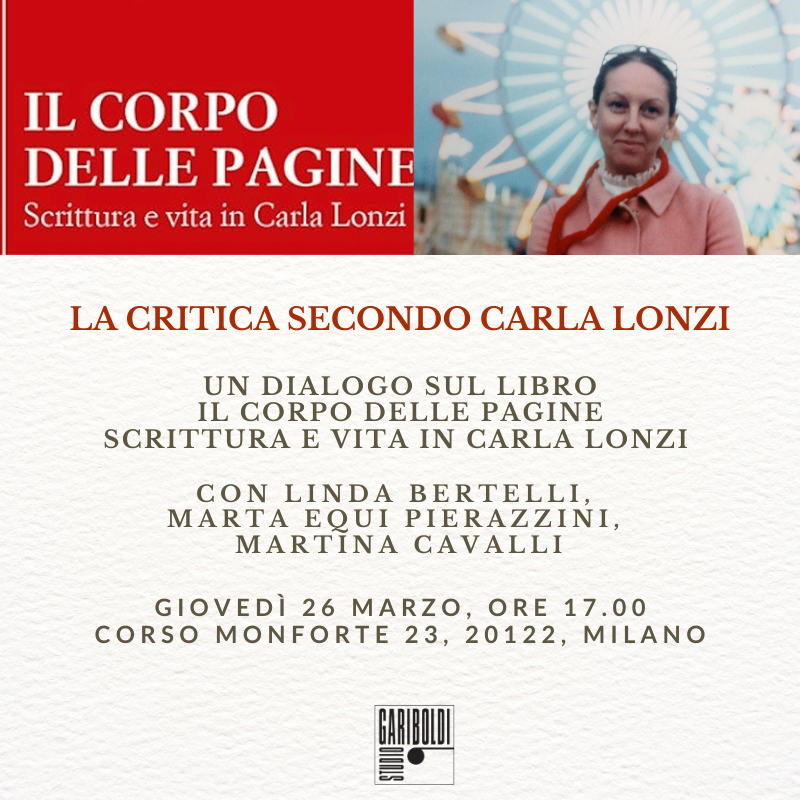
Studio Gariboldi is pleased to invite you to the talk Criticism According to Carla Lonzi, an in-depth exploration of the life and writing of one of the most remarkable figures of 20th-century Italian culture.
Carla Lonzi, writer and scholar, maintained a special relationship with leading figures of 1960s art—Carla Accardi, Lucio Fontana, Jannis Kounellis, Getulio Alviani, Enrico Castellani, Pietro Consagra, and Salvatore Scarpitta, to name just a few. Through listening and conversation, Lonzi challenged the authority of the critic and redefined art criticism as a relational practice: “Today one can be close to artists also by listening to them and then listening to them again (…). But how can you, after making such a gesture (…), return to the old one?” (Carla Lonzi, Autoritratto, 1969). Studio Gariboldi brings this compelling figure back to the center of the debate, highlighting both her research methods and the substance of her work, thanks to the rigor and insight of two young scholars.
The dialogue between Linda Bertelli and Marta Equi Pierazzini will focus on their essay Il corpo delle pagine. Scrittura e vita in Carla Lonzi (Moretti & Vitali, 2024). The book offers a re-reading of Lonzi’s trajectory, emphasizing the inseparable connection between writing and life, and between political practice and expressive form.
Joining them will be researcher Martina Cavalli.
Free admission, booking required at: press@studiogariboldi.com
Art&Cinema
Sound of Falling
23.03.2026
Listening to silence. Crossing emptiness. Remaining, despite everything.
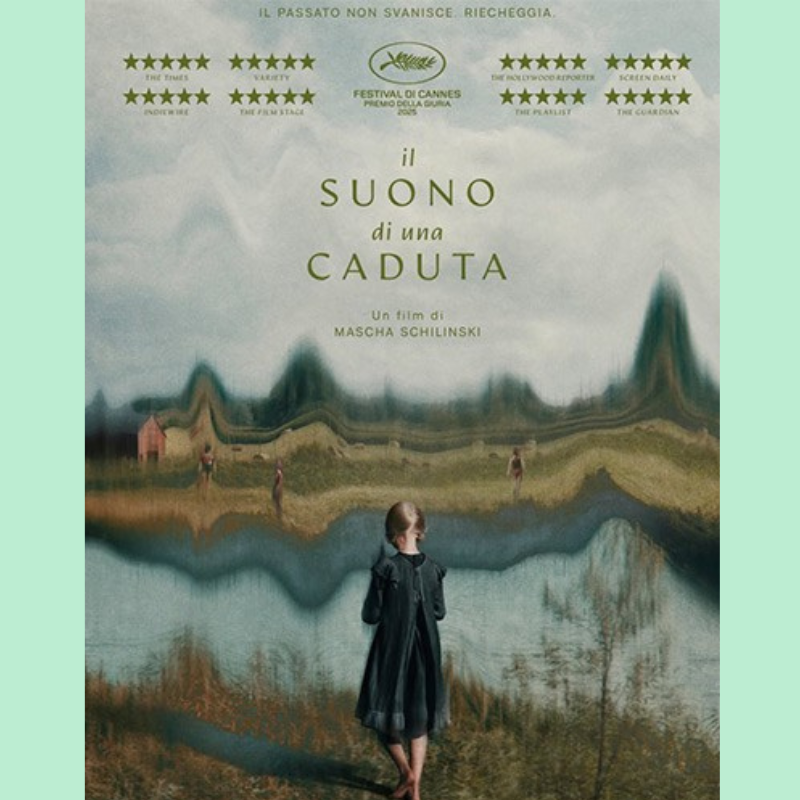
We chose to write about The Sound of Falling by Mascha Schilinski because it explores the most subtle tensions present in every human relationship and what unfolds beneath the surface of events. What interests us is precisely this gaze into the invisible cracks of relationships and those moments when something breaks, and at the same time is redefined.
The “fall” of the title is not only physical, but also internal. Within this fragile space move complex female figures, portrayed at every stage of life, far from any stereotype.
The environments themselves deeply participate in the narrative. The set design by Cosima Vellenzer, with peeling walls, matte surfaces, and rooms crossed by an almost dusty light, transforms domestic spaces into places of memory, as if time were settling onto things. Fabian Gamper, the film’s cinematographer, accompanies this dimension with suspended images in which natural light seems to emerge from within the spaces.
Some shots recall the imagery of photographer Francesca WoodmanFrancesca Woodman, where bodies interact with walls, doors, and mirrors until they almost dissolve into them.
It is a cinema made of silence, light, and interior architectures, where each image seems to hold the exact moment in which something falls and transforms.
Gallery life
Artists’materials: marble
20.03.2026
Do we truly know which materials we bring into our homes when we acquire a work of art? Their properties and symbolic meanings can influence the quality of our lives and, above all, our state of mind. An artwork is not made solely of ingenuity, creativity, or technique, but also of supports, binders, essences, and material details. The work of the gallerist also involves knowledge of these aspects, which often require long periods of research to be fully understood and reconstructed.
Following the first feature dedicated to wood and its use in the works of Tomonori Toyofuku, we continue this journey with a second material: marble, one of the materials used by Aiko Miyawaki in her research in the 1960s.
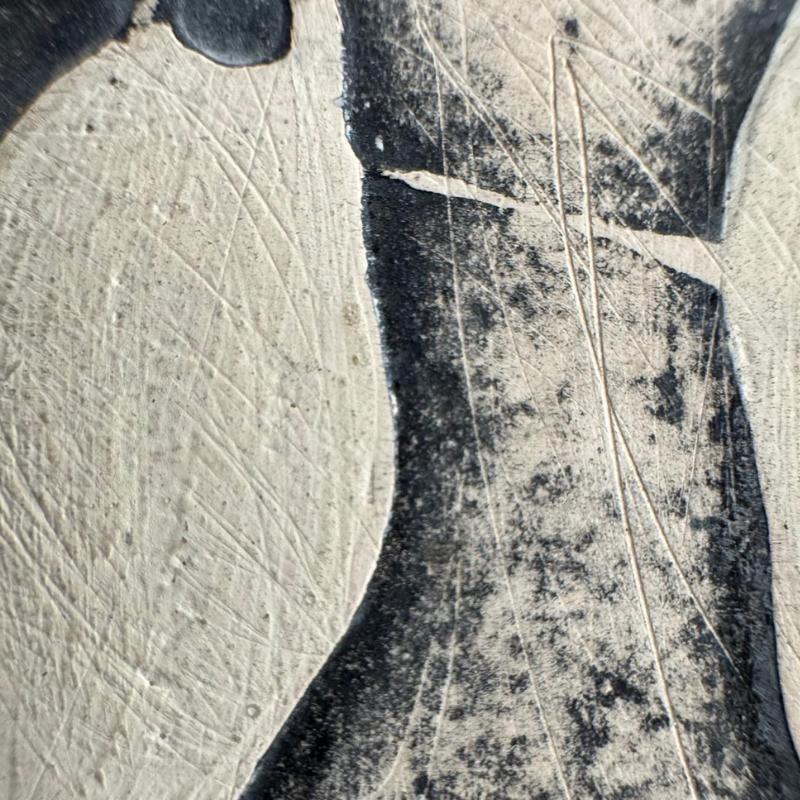
The Japanese artist used marble powder mixed with oil or synthetic binders, applying it onto panels to create delicately textured, almost sculptural surfaces. Through this process, she evoked the Japanese sensibility of wabi-sabi, embracing beauty in imperfection and impermanence, while engaging the viewer in a quiet dialogue of light, shadow, and material presence. In the postwar context, her work resonates as a search for balance between tradition and modernity, where even the densest matter seems to breathe with a subtle life.
Marble has long been a symbol of purity, endurance, and memory. A noble and compact material, capable of enduring through centuries without losing its identity, it represents a form of permanence that resists time, while at the same time preserving its traces. In its powdered form—fragmented and recomposed—this solidity transforms into a sensitive surface, revealing a new dimension of matter: more fragile, yet also more intimate and contemplative.
In the picture: Aiko Miyawaki, Untitled, 1964, mineral powder with binder, painted on board, detail.
ITALY–JAPAN. Japanese artists in Milan since 1960
until April 30, 2026
Corso Monforte 23, 20122, Milan