NEWS
Gallery life
Artists’materials: metal
25.03.2026
Do we truly know which materials we bring into our homes when we acquire a work of art? Their physical properties and symbolic meanings can influence the quality of our lives and, above all, our state of mind.
A work of art is not made solely of ingenuity, creativity, or technique, but also of supports, binders, substances, and material details. The gallerist’s work also involves understanding these aspects, which often require long periods of research to be fully reconstructed.
After our in-depth features on wood and marble, used by the artists Tomonori Toyofuku and Aiko Miyawaki, we continue this journey with a third material: metal.
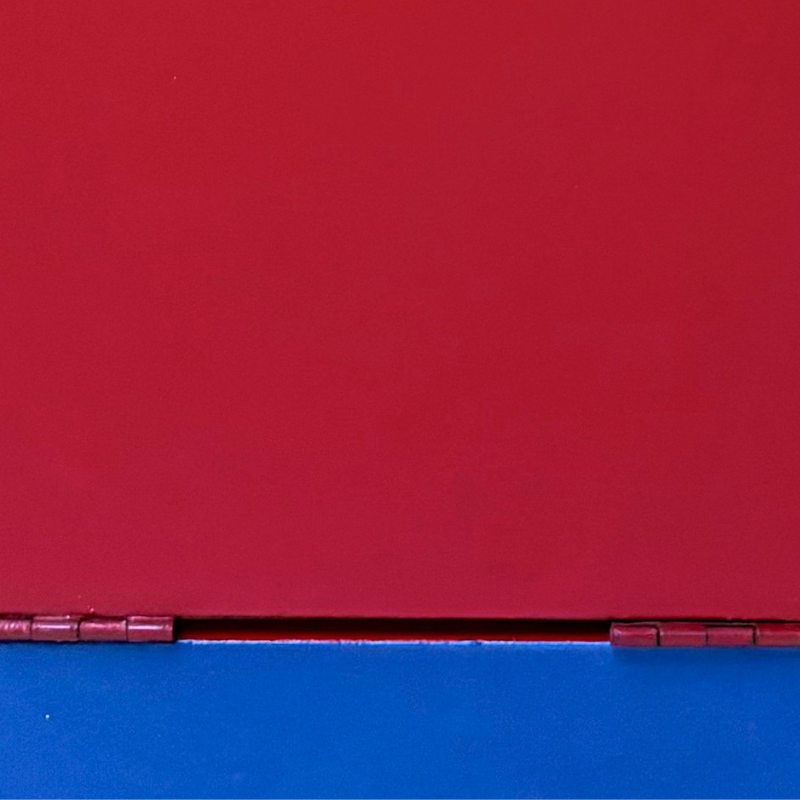
In the works of Katsumi Nakai, metal hinges transform painted panels into interactive, three-dimensional forms, suggesting movement, change, and a constant tension between surface and volume. At the same time, they evoke the Japanese concept of ma, the meaningful space between things. The hinges thus become symbols of transformation and openness, activating a dynamic dialogue between matter and space and turning static surfaces into ever-evolving forms.
In the image: Katsumi Nakai, Untitled, 1968, acrylic on shaped wood, detail.
ITALY–JAPAN. Japanese artists in Milan since 1960
until April 30, 2026
Corso Monforte 23, 20122, Milan
FullOfArt
Criticism according to Carla Lonzi
24.03.2026
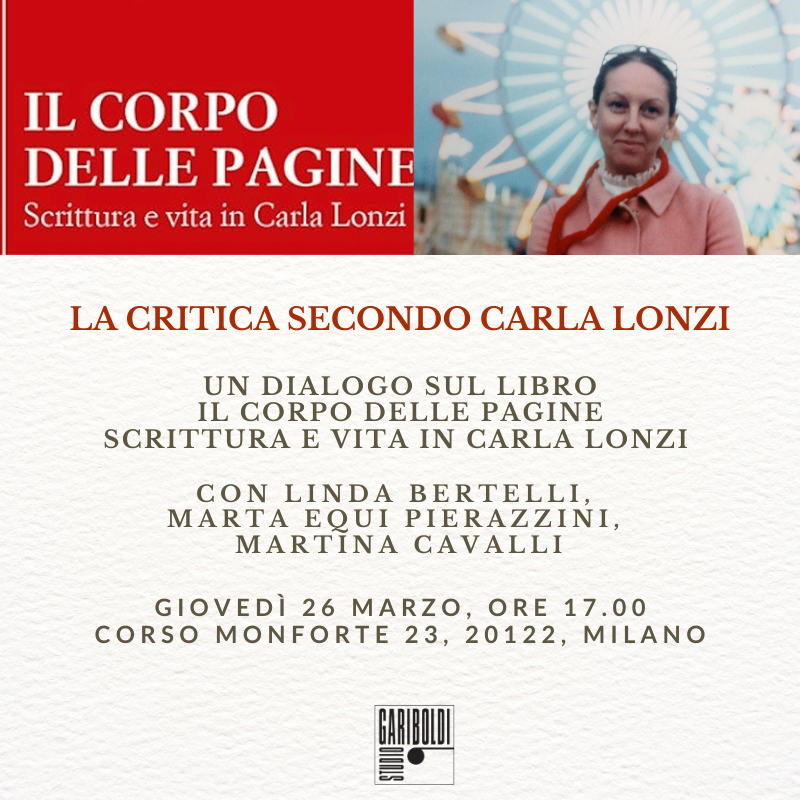
Studio Gariboldi is pleased to invite you to the talk Criticism According to Carla Lonzi, an in-depth exploration of the life and writing of one of the most remarkable figures of 20th-century Italian culture.
Carla Lonzi, writer and scholar, maintained a special relationship with leading figures of 1960s art—Carla Accardi, Lucio Fontana, Jannis Kounellis, Getulio Alviani, Enrico Castellani, Pietro Consagra, and Salvatore Scarpitta, to name just a few. Through listening and conversation, Lonzi challenged the authority of the critic and redefined art criticism as a relational practice: “Today one can be close to artists also by listening to them and then listening to them again (…). But how can you, after making such a gesture (…), return to the old one?” (Carla Lonzi, Autoritratto, 1969). Studio Gariboldi brings this compelling figure back to the center of the debate, highlighting both her research methods and the substance of her work, thanks to the rigor and insight of two young scholars.
The dialogue between Linda Bertelli and Marta Equi Pierazzini will focus on their essay Il corpo delle pagine. Scrittura e vita in Carla Lonzi (Moretti & Vitali, 2024). The book offers a re-reading of Lonzi’s trajectory, emphasizing the inseparable connection between writing and life, and between political practice and expressive form.
Joining them will be researcher Martina Cavalli.
Free admission, booking required at: press@studiogariboldi.com
Art&Cinema
Sound of Falling
23.03.2026
Listening to silence. Crossing emptiness. Remaining, despite everything.
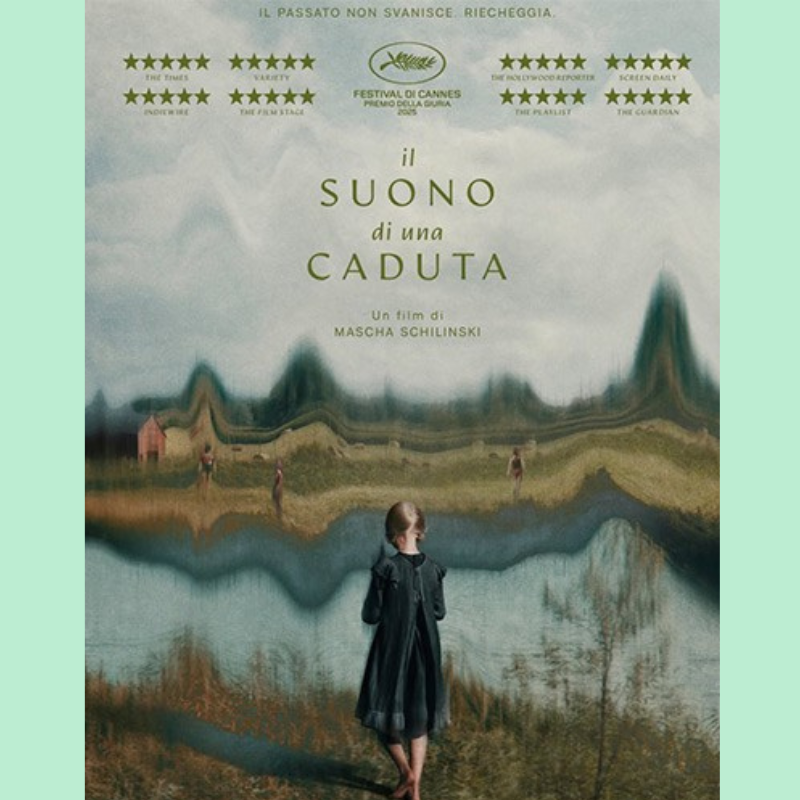
We chose to write about The Sound of Falling by Mascha Schilinski because it explores the most subtle tensions present in every human relationship and what unfolds beneath the surface of events. What interests us is precisely this gaze into the invisible cracks of relationships and those moments when something breaks, and at the same time is redefined.
The “fall” of the title is not only physical, but also internal. Within this fragile space move complex female figures, portrayed at every stage of life, far from any stereotype.
The environments themselves deeply participate in the narrative. The set design by Cosima Vellenzer, with peeling walls, matte surfaces, and rooms crossed by an almost dusty light, transforms domestic spaces into places of memory, as if time were settling onto things. Fabian Gamper, the film’s cinematographer, accompanies this dimension with suspended images in which natural light seems to emerge from within the spaces.
Some shots recall the imagery of photographer Francesca WoodmanFrancesca Woodman, where bodies interact with walls, doors, and mirrors until they almost dissolve into them.
It is a cinema made of silence, light, and interior architectures, where each image seems to hold the exact moment in which something falls and transforms.
Gallery life
Artists’materials: marble
20.03.2026
Do we truly know which materials we bring into our homes when we acquire a work of art? Their properties and symbolic meanings can influence the quality of our lives and, above all, our state of mind. An artwork is not made solely of ingenuity, creativity, or technique, but also of supports, binders, essences, and material details. The work of the gallerist also involves knowledge of these aspects, which often require long periods of research to be fully understood and reconstructed.
Following the first feature dedicated to wood and its use in the works of Tomonori Toyofuku, we continue this journey with a second material: marble, one of the materials used by Aiko Miyawaki in her research in the 1960s.
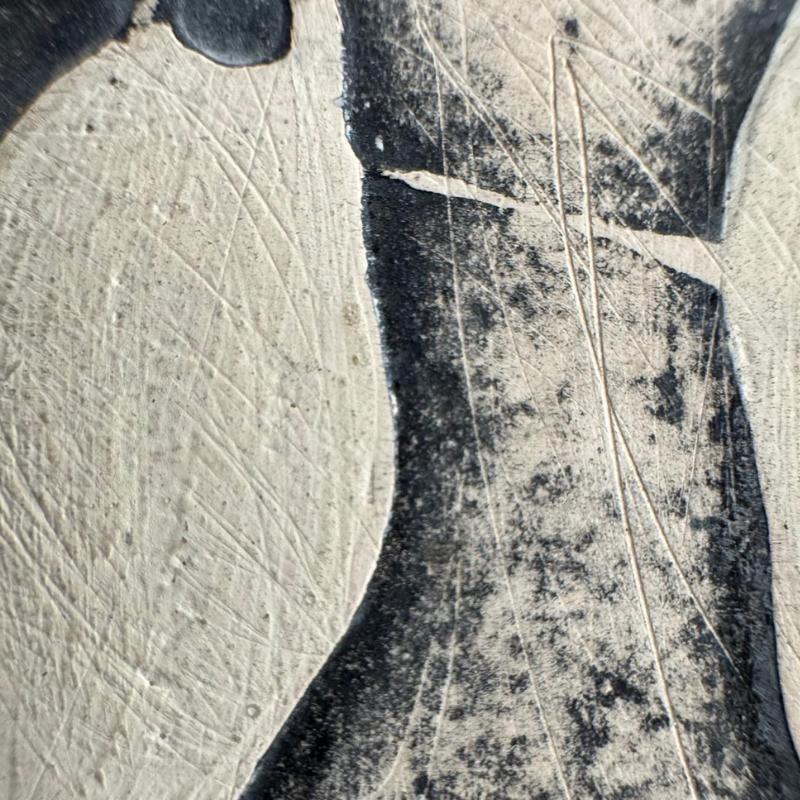
The Japanese artist used marble powder mixed with oil or synthetic binders, applying it onto panels to create delicately textured, almost sculptural surfaces. Through this process, she evoked the Japanese sensibility of wabi-sabi, embracing beauty in imperfection and impermanence, while engaging the viewer in a quiet dialogue of light, shadow, and material presence. In the postwar context, her work resonates as a search for balance between tradition and modernity, where even the densest matter seems to breathe with a subtle life.
Marble has long been a symbol of purity, endurance, and memory. A noble and compact material, capable of enduring through centuries without losing its identity, it represents a form of permanence that resists time, while at the same time preserving its traces. In its powdered form—fragmented and recomposed—this solidity transforms into a sensitive surface, revealing a new dimension of matter: more fragile, yet also more intimate and contemplative.
In the picture: Aiko Miyawaki, Untitled, 1964, mineral powder with binder, painted on board, detail.
ITALY–JAPAN. Japanese artists in Milan since 1960
until April 30, 2026
Corso Monforte 23, 20122, Milan
Art&Cinema
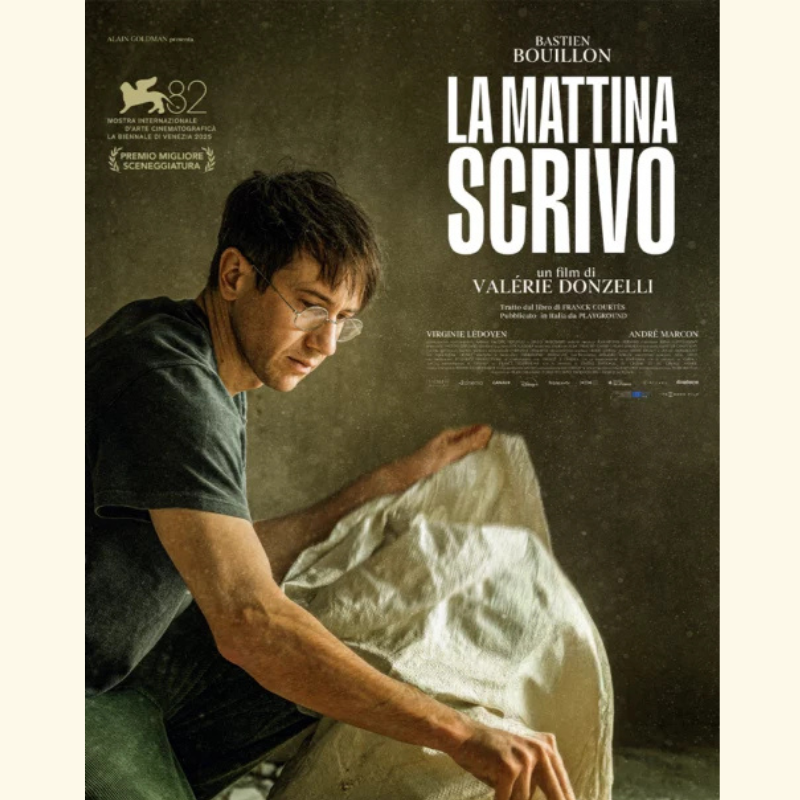
In the morning I write
17.03.2026
In the morning I write, directed by Valérie Donzelli, is a film dedicated to artists—writers, painters, musicians alike.
At its center is a man who earns his living as a photographer, yet whose deepest sense of fulfillment lies in another form of art: not photography, but writing.
After publishing a few books, he begins to see himself as a writer and decides to remain one, no matter the cost. And the cost is high. His is a radical choice: mornings are devoted to his art, afternoons to exhausting, poorly paid work of any kind.
Around him are a wife and two grown children, born when he was very young, who sometimes criticize him but, above all, support him. A father and a sister provide him with minimal shelter, while remaining judgmental and irritated. Together with his editor, they constantly challenge him, gradually undermining his confidence.
It is a film where walls crumble—the opening scene, a sheetrock wall hacked apart until it collapses, becomes a perfect metaphor for the entire story—where the balconies of Paris are planted by bleeding hands, and the inner gardens of luxury homes are trimmed with shears. Ugly paintings hang on the walls; Paris itself appears almost unrecognizable.
What makes the film so compelling is that it speaks to artists about artists: the radical ones, poor and bound to survival and integrity toward their work, and the fortunate ones, supported by generous families and comfortably settled into their privilege.
Gallery life
Artists’materials: wood
16.03.2026
Do we really know which materials we bring into our homes when we acquire a work of art? Their properties and symbolic meanings can influence the quality of our lives and, above all, our state of mind. An artwork is not only about ingenuity, creativity, or technique, but also about supports, binders, essences, and material details. Part of a gallerist’s work is precisely the knowledge of these aspects, which often require long periods of research to be fully understood.
From time to time, you will find insights on these topics here. The first focuses on the wood used by Tomonori Toyofuku in the 1960s.
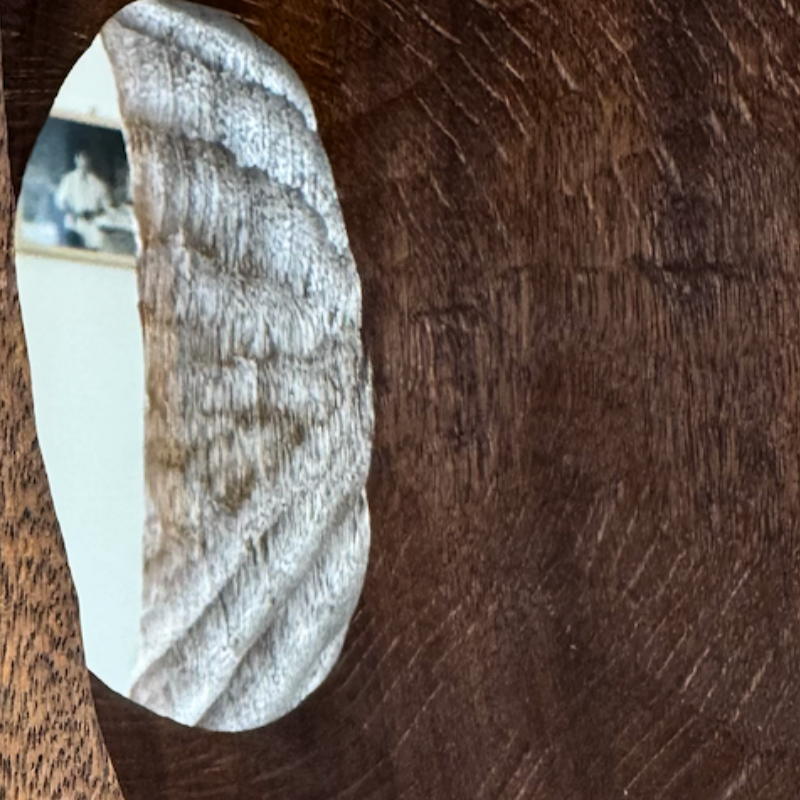
The Japanese sculptor often chose mahogany for his works, drawn both to its formal qualities and its physical properties. His sculptures feature abstract, pierced forms and recurring oval motifs, achieved through a process of carving and perforation that creates an intense dialogue between solids and voids. Mahogany—durable yet relatively easy to work—allowed him to create deep cuts and precise cavities while preserving the structural integrity of the piece. Its warm tone, regular grain, and smooth surface further enhance the relationship between light, form, and space that defines his sculptural research.
Mahogany is widely regarded as a symbol of strength, stability, and reliability. A solid and resilient wood, its remarkable hardness and resistance to warping in humid conditions make it a powerful metaphor for an inner strength that does not falter in the face of adversity.
In the picture: Tomonori Toyofuku, Untitled, 1987, carved wood, 42 × 23 × 18 cm. Detail.
ITAlY-JAPAN. Japanese artists in Milan since 1960s
until 30 April 2026
Corso Monforte 23, 20122, Milan

Art&Cinema
Rental Family: Japan and the Architecture of Feelings
10.03.2026
We chose Rental Family, directed by the Japanese filmmaker Hirari, for four key reasons.
1. Tokyo: vast yet intimate
Through the film, we explore Tokyo by entering its homes, restaurants, and private spaces.
2. The delicate beauty of small things
Among these moments is a hanger decorated with colorful, transparent jellyfish crafted from plastic bottles by a beautiful little girl.
3. Relationships and distance
The film reflects how human connections are shaped by the physical and emotional distance between people. The space that separates us often defines who we become in the eyes of others.
4. Pure aesthetics and visual storytelling
Rental Family is a theatre of life. Takurô Ishizaka’s cinematography first captures emotional coldness through cool, blue tones, then gradually warms up as the characters transform. Every frame feels like a painting, and together with the soundtrack, it creates a film within the film. In the end, what stays with the viewer are houses, tree roots, small backpacks, intimate interiors—images that collectively shape the identity of the characters.
This film resonates with us because every object, color, and shape we bring into our homes marks us and speaks about who we are to others.
Press
Studio Gariboldi at Salon d’Art Genève
09.03.2026
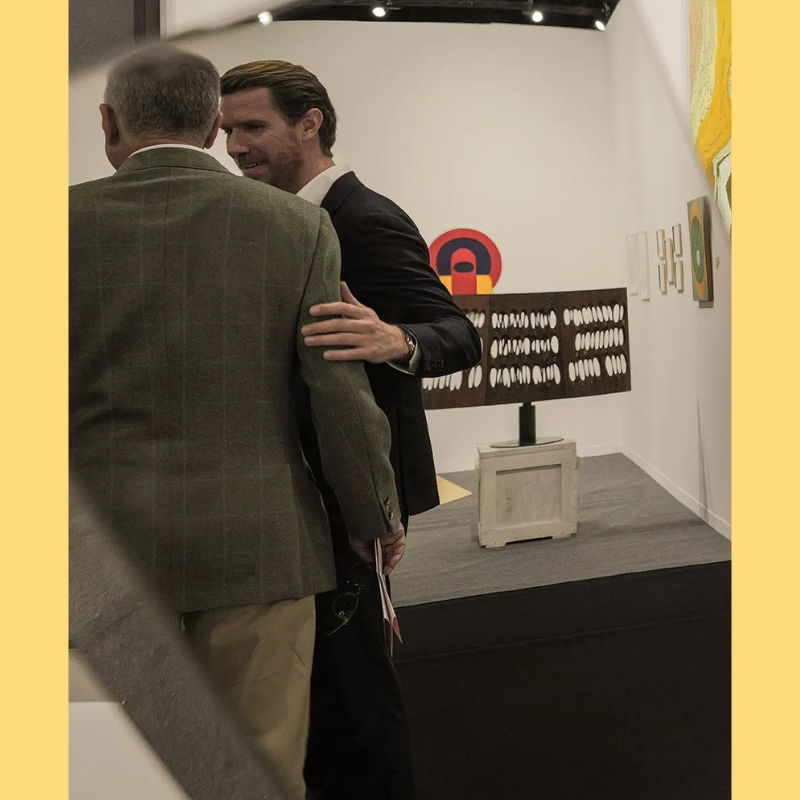
On the occasion of Art Genève 2026, Bilan Magazine dedicated an article to the Salon d’Art. In this case, it is not words but images that speak about us.
Photographer Laurent Guiraud captured a shot on the reflective surface of an artwork placed in front of our stand. The result? You can clearly see a painting by Katsumi Nakai hanging on the wall and a sculpture by Tomonori Toyofuku in the foreground.
Respectively:
Katsumi Nakai, Untitled, late 1970s, acrylic on shaped wood, 57 × 57 cm
Tomonori Toyofuku, Untitled, 1985, shaped wood, 115 × 85 × 6 cm
Below is the Italy–Japan press review