Gallery life
Artists’materials: marble
20.03.2026
Do we truly know which materials we bring into our homes when we acquire a work of art? Their properties and symbolic meanings can influence the quality of our lives and, above all, our state of mind. An artwork is not made solely of ingenuity, creativity, or technique, but also of supports, binders, essences, and material details. The work of the gallerist also involves knowledge of these aspects, which often require long periods of research to be fully understood and reconstructed.
Following the first feature dedicated to wood and its use in the works of Tomonori Toyofuku, we continue this journey with a second material: marble, one of the materials used by Aiko Miyawaki in her research in the 1960s.
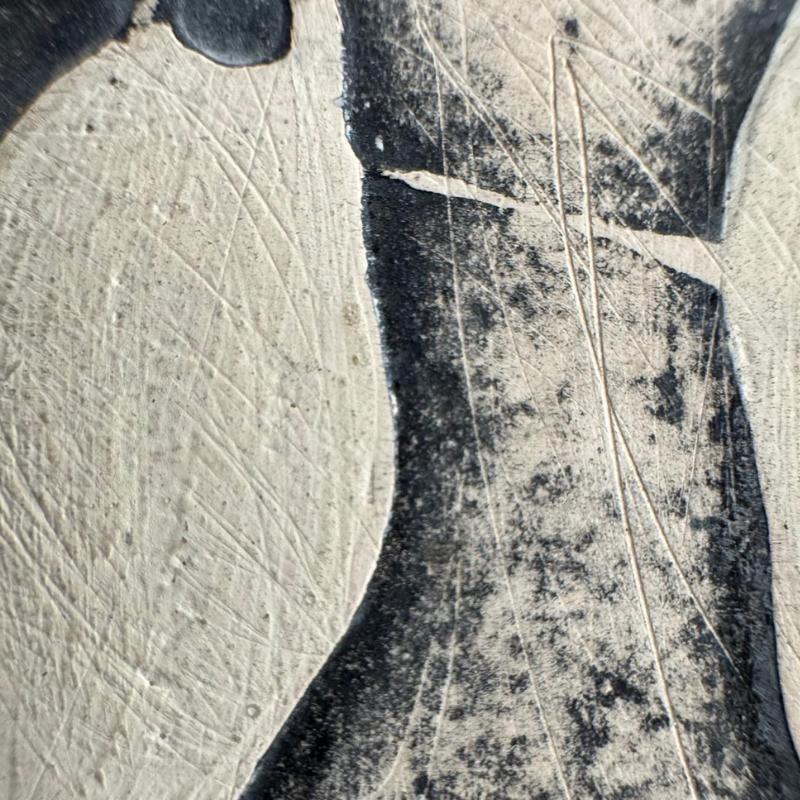
The Japanese artist used marble powder mixed with oil or synthetic binders, applying it onto panels to create delicately textured, almost sculptural surfaces. Through this process, she evoked the Japanese sensibility of wabi-sabi, embracing beauty in imperfection and impermanence, while engaging the viewer in a quiet dialogue of light, shadow, and material presence. In the postwar context, her work resonates as a search for balance between tradition and modernity, where even the densest matter seems to breathe with a subtle life.
Marble has long been a symbol of purity, endurance, and memory. A noble and compact material, capable of enduring through centuries without losing its identity, it represents a form of permanence that resists time, while at the same time preserving its traces. In its powdered form—fragmented and recomposed—this solidity transforms into a sensitive surface, revealing a new dimension of matter: more fragile, yet also more intimate and contemplative.
In the picture: Aiko Miyawaki, Untitled, 1964, mineral powder with binder, painted on board, detail.
ITALY–JAPAN. Japanese artists in Milan since 1960
until April 30, 2026
Corso Monforte 23, 20122, Milan