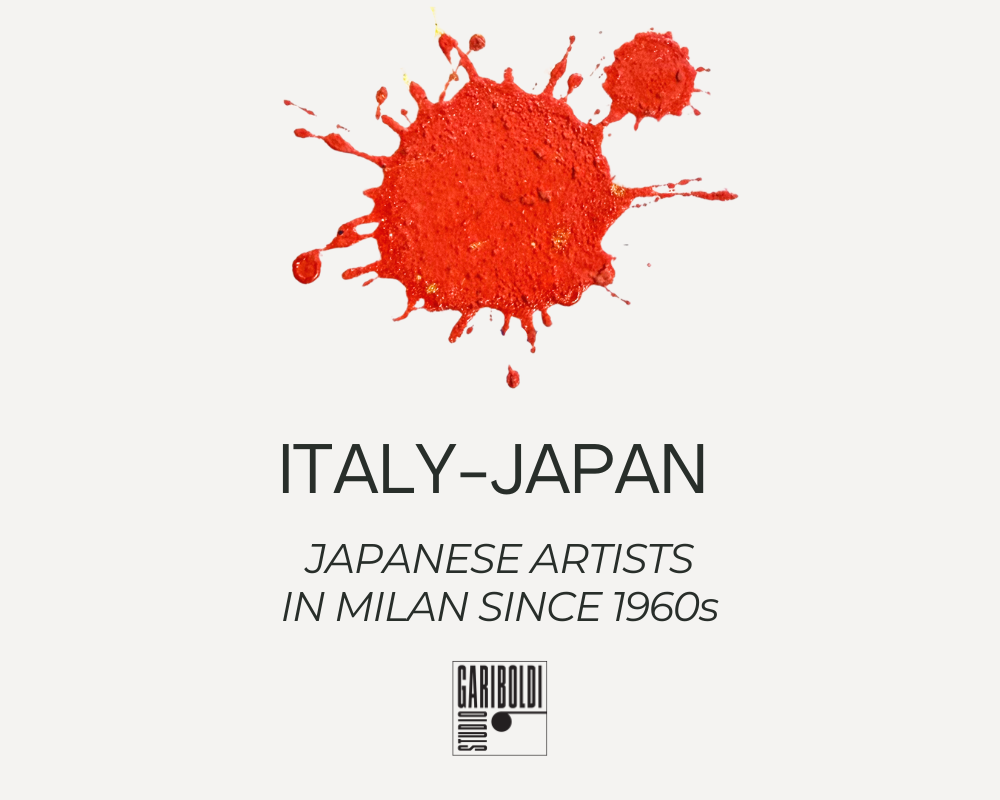
ITALY – JAPAN
Japanese artists in Milan since 1960s
The project reexamines modern art history by emphasizing cultural exchange as a key force behind innovation before globalization. Artists such as Katsumi Nakai, Tomonori Toyofuku, Nobuya Abe, Key Hiraga, and Aiko Miyawaki blended Eastern sensibilities with European forms, anticipating a transnational vision of art.
Read here the press review ITALY-JAPAN
until 30 April 2026
From Monday to Friday, from 11am to 1pm and from 2pm to 6pm
Info at press@studiogariboldi.com
✨Full of Art è un progetto di Studio Gariboldi in cui l’arte si intreccia alla letteratura, al cinema e alla musica.
Scrittori, saggisti, filmaker, pittori, si alternano in galleria, e dialogano tra loro e con il pubblico.
La dimensione degli incontri è intima e approfondita, per questo l’ingresso è libero ma la prenotazione è obbligatoria.
I prossimi due appuntamenti:
🔹21 maggio, ore 17.00
Le preziose carte giapponesi di Lucio Passerini.
Con Paolo Linetti e Chiara Bottelli.
Un incontro dedicato alla ricerca di Lucio Passerini: materia, segno e cultura si intrecciano in un racconto che attraversa tradizione e contemporaneità.
🔹18 giugno, ore 17.00
Viaggio in Giappone. La geografia e le case.
Con Francesca Scotti, Marta Fanasca, Damiana De Gennaro.
Un dialogo a più voci per esplorare il paesaggio giapponese attraverso l’architettura, la geografia e le storie che abitano i luoghi.
📌 Corso Monforte 23, Milano
Ingresso libero, prenotazione obbligatoria
✉️ press@studiogariboldi.com
Con il patrocinio del Consolato Generale del Giappone a Milano
***
#arteletteratura #fullofart #studiogariboldi #elisabettabucciarelli

ITALY-JAPAN, Japanese artists in Milan since 1960s.
The project offers a renewed perspective on the history of modern art, highlighting cultural exchange as a central driver of artistic innovation well before globalization became a defining paradigm. Artists such as #KatsumiNakai, #TomonoriToyofuku, #NobuyaAbe, #AikoMiyawaki and #KeyHiraga developed original approaches to abstract painting and sculpture by merging Eastern sensibilities with European formal structures, anticipating by decades a transnational understanding of artistic practice.
The exhibition also features previously unpublished archival documentation from the 1960s and 1970s.
Under the patronage of the General Japanese Consulate of Milan
🔹Through a focused curatorial framework, Studio Gariboldi reconstructs the narrative of a unique cultural bridge, largely absent from dominant international accounts. The exhibition proposes abstraction as a shared field of experimentation, neither exclusively European nor uniquely Japanese-shaped through dialogue, movement, and exchange.
🎧 @brianeno and @davidbyrneofficial : two visionary artists who blend sonic experimentation, conceptual art, and innovative pop, redefining the boundaries between music, performance, and visual culture.
***
10 February - 30 April 2026
Monday to Friday
11am - 1pm | 2pm - 6pm
Corso Monforte 23 - 20122, Milan
Info in DM or press@studiogariboldi.com
METAL
#KatsumiNakai’s metal hinges transform painted panels into interactive, three-dimensional forms, symbolizing movement, change, and the tension between plane and volume, while reflecting the Japanese concept of “ma”—the meaningful space between objects.
🔹The metal hinges in Nakai’s works symbolize transformation, openness, and the dynamic interplay between matter and space, turning static painted surfaces into interactive, evolving forms.
Italy–Japan. Japanese Artists in Milan since 1960s
Until 30 April 2026
Mon-Fri | 11am-1pm / 2-6pm
Corso Monforte 23, 20122, Milan
🎧 @niklaspaschburg German composer and pianist. Niklas blends piano, electronics, and ambient textures into a distinctive neoclassical sound. Inspired by nature, he transforms landscapes into intimate, cinematic compositions.
***
#studiogariboldi #giovannigariboldi #modernjapaneseart #japaneseart
MARBLE
#AikoMiyawaki employed marble powder blended with oil or synthetic binders, layering it onto panels to create delicately textured, almost sculptural surfaces. Through this, she evoked the Japanese sensibility of wabi-sabi, finding beauty in imperfection and impermanence, while engaging the viewer with a quiet dialogue of light, shadow, and material presence. In the postwar era, her work resonates with a search for balance between tradition and modernity, where even the densest matter seems to breathe with subtle life.
🔹The symbolic meaning of marble powder lies in imperfect beauty, expressing elegance through imperfection, impermanence, and the natural character of materials.
1. Aiko Miyawaki, Untitled, 1964, Mineral powder with binder on board, 11x22x2 cm, detail.
2. Aiko Miyawaki, Untitled, 1964, Mineral powder with binder on board, 11x22x2 cm, detail.
3. Aiko Miyawaki, Untitled, 1964, Mineral powder with binder on board, 11x22x2 cm.
4. Installation view Italy–Japan. Japanese Artists in Milan since 1960s. Studio Gariboldi, Milan.
🔹Italy–Japan. Japanese Artists in Milan since 1960s
Until 30 April 2026
Mon-Fri | 11am-1pm / 2-6pm
Corso Monforte 23, 20122, Milan
🎧 @grouplistening Stephen Black and Paul Jones return to a shared language, reworking ambient compositions by Brian Eno, Arthur Russell, Laraaji and Robert Wyatt into intimate dialogues for clarinet and piano. A quiet space where listening becomes collective.
***
#studiogariboldi #giovannigariboldi #modernjapaneseart #arteinformale
WOOD
The Japanese sculptor #TomonoriToyofuku often used mahogany wood in his sculptures for reasons related both to formal research and to the physical characteristics of the material.
Tomonori Toyofuku’s works are characterized by pierced abstract forms and repeated oval motifs, created by carving and perforating the material to produce a strong three-dimensional effect and a play between solid and empty spaces. He often used mahogany because it is strong but easy to carve, allowing him to create deep cuts and precise cavities while keeping the sculpture structurally solid. His technique was subtractive, meaning he removed material to reveal the final form. Mahogany also has aesthetic qualities such as a warm color, regular grain, and smooth finish, which enhance the surfaces and highlight the relationship between light, form, and empty space.
🔸Mahogany wood has long been a symbol of prestige, strength, elegance, and tradition.
1.Tomonori Toyofuku, Untitled, 1987, carved wood, 42 × 23 × 18 cm. Detail.
2.Tomonori Toyofuku, Untitled, 1985, shaped wood, 115 × 85 × 6 cm. Detail.
3.Tomonori Toyofuku’s working tools. Courtesy @natsuko_toyofuku
4. installation view Italy–Japan. Japanese Artists in Milan since 1960s. Studio Gariboldi, Milan.
🔸Italy–Japan. Japanese Artists in Milan since 1960s
Untile 30 April 2026
Mon-Fri | 11am-1pm / 2-6pm
Corso Monforte 23, 20122, Milan
🎧 @brianeno is a British composer and producer, widely considered a pioneer of ambient music.
Since the 1970s, his experimental approach has reshaped the relationship between sound, art, and technology.
***
#studiogariboldi #giovannigariboldi #modernjapaneseart #japaneseart